The University of Ibadan (UI) admission requirements for 2026 are among the most sought-after pieces of information by JAMB candidates across Nigeria. Established in 1948 as the first university in Nigeria, the University of Ibadan has consistently ranked as the number one university in Nigeria and one of the top universities on the African continent. Getting into UI is genuinely competitive, but it is absolutely achievable with the right preparation and knowledge of exactly what the institution requires. This guide covers UI’s general admission requirements, departmental cut-off marks for 2026, the Post-UTME process, O’Level requirements by faculty, and practical strategies to give yourself the best chance of admission.
University of Ibadan: Quick Overview
The University of Ibadan (UI) is a federal university located in Ibadan, Oyo State. It is consistently ranked as Nigeria’s premier university by QS World University Rankings, NUC, and independent ranking bodies. Key facts about UI in 2026:
- Founded: 1948 (as University College of Ibadan; became independent in 1962)
- Type: Federal University (fully funded by the Federal Government of Nigeria)
- Faculties: 13 faculties including Agriculture, Arts, Basic Medical Sciences, Clinical Sciences, Dentistry, Education, Law, Pharmacy, Public Health, Science, Social Sciences, Technology, and Veterinary Medicine
- Student Population: Approximately 25,000–30,000 undergraduate students
- Campus: Over 1,000 hectares in Ibadan — one of the largest and most beautiful campuses in West Africa
- NUC Accreditation: All programmes fully accredited
General JAMB Cut-Off Mark for University of Ibadan 2026
The University of Ibadan sets its institutional JAMB cut-off at 200 marks for the 2026 academic session. This means that only candidates who scored 200 and above in the 2026 JAMB UTME are eligible to apply for UI Post-UTME screening. However, scoring 200 is only the entry ticket to Post-UTME — it does not guarantee admission.
In practice, given the highly competitive nature of UI admission, candidates who score below 250 face very slim chances of admission into competitive programmes. For top-tier courses like Medicine, Dentistry, Law, and Pharmacy, candidates with JAMB scores below 280 are rarely competitive at the aggregate level, even with strong Post-UTME performance.
UI Departmental Cut-Off Marks 2026: By Course
UI publishes departmental aggregate cut-off marks that reflect the minimum aggregate score (JAMB + Post-UTME combined on UI’s formula) required for each programme. Based on the published 2025/2026 cut-off data, here are the aggregate cut-offs for key programmes:
Faculty of Clinical Sciences (Highest Competition)
- Medicine and Surgery: 78.875 (highest cut-off at UI)
- Nursing Science: 71.375
- Dentistry: 68.625
- Medical Rehabilitation: 65.0
Faculty of Technology
- Mechanical Engineering: 70.5
- Electrical and Electronic Engineering: 68.5
- Civil Engineering: 67.25
- Computer Science: 69.0
- Chemical Engineering: 66.875
Faculty of Law
- Law: 70.875
Faculty of Pharmacy
- Pharmacy: Approximately 67–70 (competitive)
Faculty of Science
- Mathematics: 60.5
- Physics: 59.75
- Chemistry: 58.25
- Biochemistry: 63.5
- Microbiology: 62.0
Faculty of Social Sciences
- Economics: 62.5
- Political Science: 58.0
- Psychology: 60.0
- Sociology: 55.0
Faculty of Agriculture
Most agriculture programmes (Crop Science, Animal Science, Soil Resources Management, Agricultural Economics) have aggregate cut-offs around 50–55 — making them among the more accessible programmes at UI for candidates with moderate JAMB scores.
Faculty of Arts and Education
Most arts and education programmes have aggregate cut-offs around 50–57. English Language (56.5) and Linguistics (56.875) are slightly above the general Arts cut-off.
UI Admission Categories: Merit, Catchment, and ELDS
UI offers admission under three categories, each with different cut-off levels:
1. Merit Admission
Merit admission is open to all candidates from any state in Nigeria, regardless of origin. Merit cut-offs are the highest — these are the departmental cut-offs listed above. If you meet the merit cut-off, your admission is purely performance-based and independent of your state of origin.
2. Catchment Area Admission
UI designates six Southwest states as its catchment area: Oyo, Ogun, Ondo, Osun, Ekiti, and Lagos. Candidates from these states qualify for slightly lower cut-offs — typically 5–10 aggregate points below the merit cut-off. If you are from any of these states, ensure you indicate your state of origin correctly in your JAMB and UI Post-UTME applications to benefit from catchment status.
3. ELDS (Educationally Less Developed States)
Federal guidelines require universities to reserve a proportion of admission spaces for candidates from educationally disadvantaged states. ELDS cut-offs are the lowest tier, allowing candidates from designated states to gain admission with lower aggregate scores than the merit threshold.
O’Level Requirements for UI Admission 2026
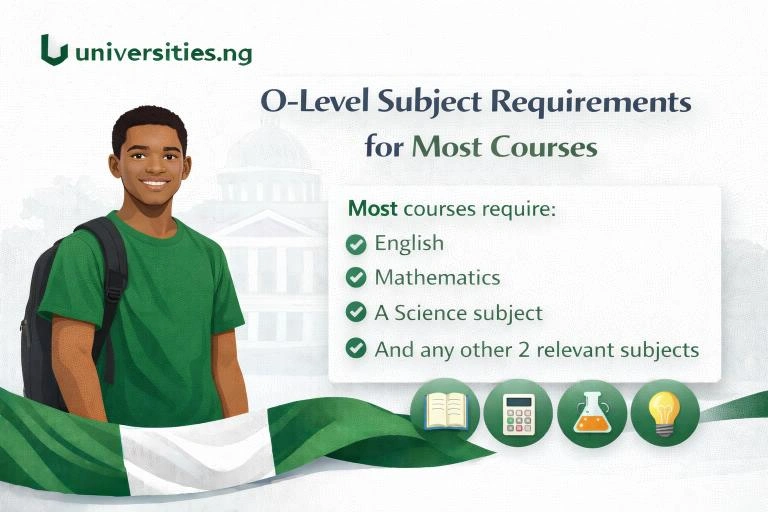
All candidates seeking UI admission must present a minimum of 5 O’Level credit passes (WAEC or NECO) including English Language and Mathematics (or Literature in English for some arts courses) in not more than two sittings. In addition, each faculty has specific subject requirements:
- Medicine, Dentistry, Pharmacy: Biology (or Botany/Zoology), Chemistry, Physics, Mathematics, English Language
- Engineering and Technology: Physics, Chemistry, Mathematics, English Language + one more relevant subject
- Law: English Language, Mathematics/Literature + three other relevant subjects
- Economics/Social Sciences: English Language, Mathematics + three relevant subjects
- Agriculture: Biology (or Agricultural Science), Chemistry, Mathematics, English Language + one more
The UI Post-UTME Screening Process
UI conducts a Post-UTME screening exercise for all candidates who meet the JAMB threshold. Here is what to expect:
- Post-UTME is typically conducted at the UI main campus in Ibadan (not CBT-based at external centres)
- The examination tests core academic competencies relevant to your course area: Sciences candidates face Physics, Chemistry, Biology and/or Mathematics questions; Arts candidates face English, General Knowledge, and subject-specific questions
- Results are combined with JAMB scores to produce the aggregate on UI’s formula: (JAMB ÷ 8) + (Post-UTME ÷ 2)
- The maximum possible aggregate is 100 (50 from JAMB + 50 from Post-UTME)
UI Post-UTME registration typically opens a few weeks after JAMB results are released and requires an online application through the UI Admissions portal at admissions.ui.edu.ng. Monitor the UI official website and official social media pages for the exact 2026 Post-UTME date and registration deadline.
To understand how the aggregate is calculated and what score you need to be competitive, read our guide on how to calculate your JAMB aggregate score for university admission 2026.
How to Maximise Your Chances of UI Admission
- Score as high as possible in JAMB. For competitive courses, every mark above 280 significantly improves your aggregate. The JAMB component can contribute up to 50 points to your aggregate — make it count.
- Prepare intensively for Post-UTME. UI Post-UTME is known to be rigorous. Use past UI Post-UTME questions (available in bookstores and online) and practice consistently in the weeks before the exam.
- Apply to courses where you are genuinely competitive. If your expected aggregate is 60, applying for Medicine (cut-off 78.875) is unrealistic. Apply strategically where your score gives you a real chance.
- Indicate catchment states if applicable. If you are from Oyo, Lagos, Ogun, Ondo, Osun, or Ekiti, ensure this is correctly reflected in both your JAMB and UI applications.
- Apply for UI admission as soon as it opens. Early applicants have more time to sort out any documentation issues before deadlines.
Frequently Asked Questions About UI Admission 2026
Q: What JAMB score do I need to get into the University of Ibadan?
The minimum JAMB score is 200. However, for competitive courses like Medicine (aggregate cut-off 78.875), Dentistry, Law, and Engineering, you realistically need 280+ in JAMB. For less competitive programmes in Agriculture and Education, 220–240 with a strong Post-UTME may be sufficient.
Q: Does UI accept candidates who scored in two sittings?
Yes, UI accepts O’Level results from two sittings for most programmes. However, for Medicine, Dentistry, and a few other highly competitive programmes, candidates with one-sitting O’Level results may have a practical advantage when aggregates are very close, as ties are broken partly by O’Level quality.
Q: Is UI Post-UTME conducted online or physically on campus?
UI typically conducts its Post-UTME screening physically on the main Ibadan campus, unlike some universities that allow CBT at remote centres. Candidates should plan for travel and accommodation in Ibadan during the Post-UTME period. UI does not currently offer a fully remote screening option for undergraduate admission.
Aim High: Your UI Admission Journey Starts Now
The University of Ibadan is Nigeria’s finest university — and being admitted is one of the most significant academic achievements available to a Nigerian student. With the right JAMB score, focused Post-UTME preparation, correct O’Level requirements, and strategic course selection, UI admission is achievable. Study hard, prepare smart, and set your sights on earning a place at this historic institution.
Check our full guide to JAMB 2026 cut-off marks for all universities and courses to compare UI requirements with other top institutions and identify your best options.